

Let me ask you something directly.
When was the last time someone in your business strongly disagreed with you? Not super politely. Not cautiously. Not wrapped in soft language.
Strongly.
If you struggle to recall a moment, that might not be a sign of harmony. It might be a sign of avoidance. And avoidance in business is expensive.
The Italian Lesson
A few years ago, during a business trip to Italy, I witnessed what I initially thought was a major falling out.
The head salesperson was animated. Loud. Direct. The two business owners were firing back just as strongly.
From the outside, it looked aggressive.
Uncomfortable.
Confrontational.
I left the room assuming relationships had been damaged.
Twenty minutes later, I discovered something surprising.
Nothing was wrong.
This was simply how they communicated.
They said what they meant. They challenged each other openly. They pushed back without hesitation.
And when the discussion ended, there was no lingering resentment.
Just clarity.
That day I learned something valuable.
The lesson wasn’t to become louder.
It was to become braver.
Why Conflict Matters in Your Business

There’s a quote often attributed to Mahatma Gandhi:
“Peace is not the absence of conflict but the ability to cope with it.”
If that’s true, then many NZ businesses are mistaking silence for peace.
You might believe your culture is healthy because meetings feel calm.
But calm does not equal productive.
Healthy conflict improves:
- Respect for differing viewpoints
- Decision quality
- Creativity and innovation
- Accountability
- Team cohesion
Research supports this.
A Harvard Business Review article titled The Value of Conflict in Teams explains that task-based conflict (debate about ideas) improves performance when managed correctly, whereas personal conflict damages it.
The distinction matters.
It’s not conflict itself that harms performance.
It’s an unproductive conflict.
Productive vs Unproductive Conflict
If you could recognise the difference in real time, you would lead differently.
Based on behavioural patterns commonly observed in teams, conflict generally falls along four spectrums:
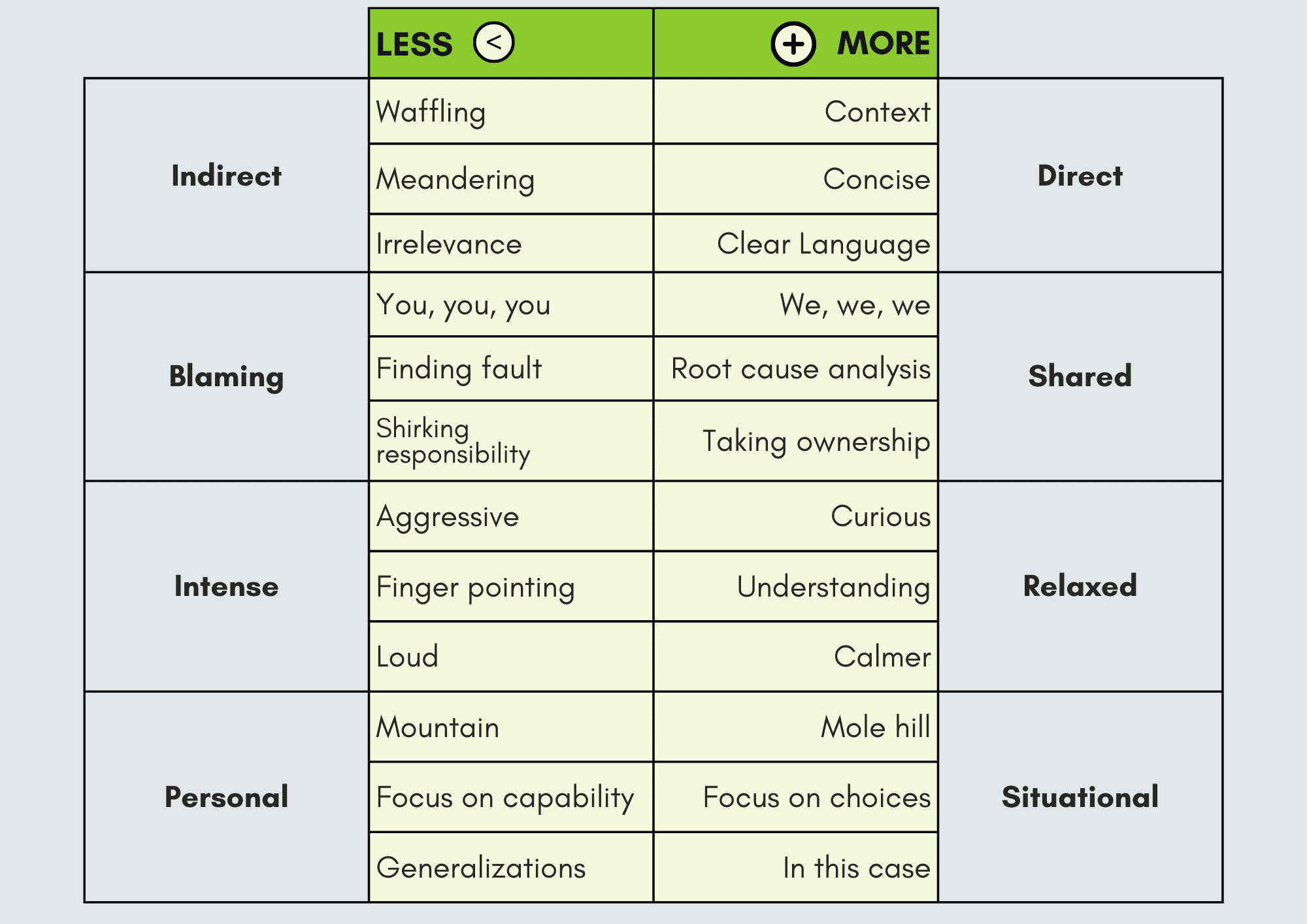
The table shows a visual summary of these behavioural tendencies. You can use this table in your leadership meetings to quickly identify whether a conversation is drifting into unproductive territory, or moving towards healthy, productive conflict.
Use this as a diagnostic tool. In the moment, ask yourself: which side of the table are we operating from right now?
1. Indirect vs Direct
Indirect conflict:
- Waffling
- Meandering
- Avoiding the real issue
Direct conflict:
- Clear language
- Concise feedback
- Context provided upfront
Many leaders in New Zealand avoid directness because it feels uncomfortable.
But indirectness often becomes passive aggression.
And passive aggression erodes trust.
2. Blaming vs Shared Ownership
Blaming conflict:
- “You always…”
- Fault finding
- Shirking responsibility
Shared conflict:
- “What happened here?”
- Root cause analysis
- Taking ownership
Blame closes discussion.
Ownership opens it.
3. Intense vs Curious
Unproductive intensity:
- Aggression
- Finger pointing
- Raised voices
Productive engagement:
- Curiosity
- Seeking understanding
- Calm exploration
Conflict does not require volume, it requires courage and curiosity.
4. Personal vs Situational
Personal conflict:
- Generalisations
- Questioning capability
- Turning molehills into mountains
Situational conflict:
- Focusing on behaviour
- Discussing specific events
- Separating person from problem
This distinction alone can transform your culture.
Why NZ Businesses Often Avoid Conflict

Culturally, we value harmony.
We avoid rocking the boat.
We don’t want to offend.
But when leaders prioritise comfort over clarity, standards slip.
People guess what you mean instead of hearing it clearly.
Feedback becomes diluted.
Resentment builds quietly.
Eventually, issues explode.
Avoidance doesn’t eliminate conflict.
It postpones it.
If you want a practical framework to better understand what your team is thinking and feeling during tension, you may find this useful: The Empathy Map Framework: Practical Leadership for Managing Staff and Improving Team Performance. It provides a structured way to unpack perspectives, reduce defensiveness and turn difficult conversations into productive progress.
The Radical Candour Balance

Kim Scott’s concept of Radical Candour describes two extremes:
- Ruinous Empathy (overly nice, avoiding hard truths)
- Obnoxious Aggression (direct but uncaring)
The sweet spot is caring personally while challenging directly.
That balance creates respect.
When your team knows you care about them, direct feedback becomes easier to receive.
And when expectations are clear, accountability strengthens.
The Cost of Conflict Avoidance
Avoiding productive conflict leads to:
- Poor strategic decisions
- Groupthink
- Reduced innovation
- Lower accountability
- Leadership isolation
Amy Edmondson’s research on psychological safety at Harvard shows that high-performing teams are not conflict-free.
They are environments where people feel safe to speak up, challenge ideas and admit mistakes.
Psychological safety is not about comfort.
It’s about openness.
Signs Your Business Needs More Conflict

Ask yourself:
- Do meetings end quickly without debate?
- Do staff rarely challenge your thinking?
- Do issues surface late?
- Are decisions revisited repeatedly?
If yes, you may not have harmony.
You may have compliance.
And compliance rarely drives excellence.
How to Introduce Productive Conflict Safely
You don’t create conflict for drama.
You create structure for clarity.
Start by:
- Modelling direct language.
- Asking for opposing viewpoints intentionally.
- Framing disagreement as problem-solving.
- Separating behaviour from identity.
- Rewarding thoughtful challenge.
Conflict becomes productive when it is purposeful.
Conflict as a Competitive Advantage
In inflationary, uncertain and competitive markets, speed of decision-making matters.
Clarity matters.
Robust debate strengthens both.
When your team can challenge ideas openly:
- Risks surface earlier
- Assumptions are tested
- Better strategies emerge
That is not cultural weakness.
That is maturity.
Final Thought
Productive conflict is not about being louder.
It is about being clearer.
It is not about winning arguments.
It is about improving outcomes.
If you can recognise in real time whether conflict is:
- Indirect or direct
- Blaming or shared
- Intense or curious
- Personal or situational
You will lead differently.
And your culture will strengthen.
If you want to take this beyond individual conversations and embed it at a team level, you may also find this valuable: How Group Coaching Boosts Team Productivity and Business Growth. It explores how structured group coaching environments encourage healthy debate, shared accountability and collective problem-solving — all essential ingredients for productive conflict and sustained business growth.
Frequently Asked Questions About Conflict in Business
1. Is conflict always healthy?
No. Personal, blaming or aggressive conflict damages trust. Task-based, respectful debate improves decision-making and performance.
2. How do I encourage disagreement without creating hostility?
Set clear rules: challenge ideas, not people. Model calm directness. Reinforce shared ownership of outcomes.
3. What if my team avoids speaking up?
Psychological safety must be built intentionally. Ask for opposing views. Thank those who challenge you. Avoid punishing dissent.
4. Can too much conflict harm productivity?
Yes. Unstructured or personal conflict drains energy. The key is disciplined, purposeful debate tied to business outcomes.
5. Why is conflict avoidance common in NZ SMEs?
Cultural preference for harmony often overrides directness. But clarity and accountability require a willingness to engage respectfully.
Ready to Strengthen Your Leadership Through Better Conflict?
If you suspect your business is avoiding important conversations, it may be time to change that.
Call Sean on 029 427 4980 or schedule a call here and let’s discuss how to increase productive conflict, improve accountability and strengthen decision-making in your business.
Not louder.
Clearer.
That’s where real performance begins.
I hope that you have found some value in the above news brief, if you would like to subscribe to get the latest, then click the button below:
Get the latest news brief here

Sean Foster
PS: Interested in working with me? I help in 3 ways:
[1] Work with me privately to improve your business profitability, scale your business & improve your personal and business productivity - Schedule an appointment here.
[2] Join BIG – in-person, group based coaching program. Operating from Silverdale, Auckland
[3] Understand & develop your behavioural habits through psychometric behavioural assessments & coaching
Liking this? Share in your socials: